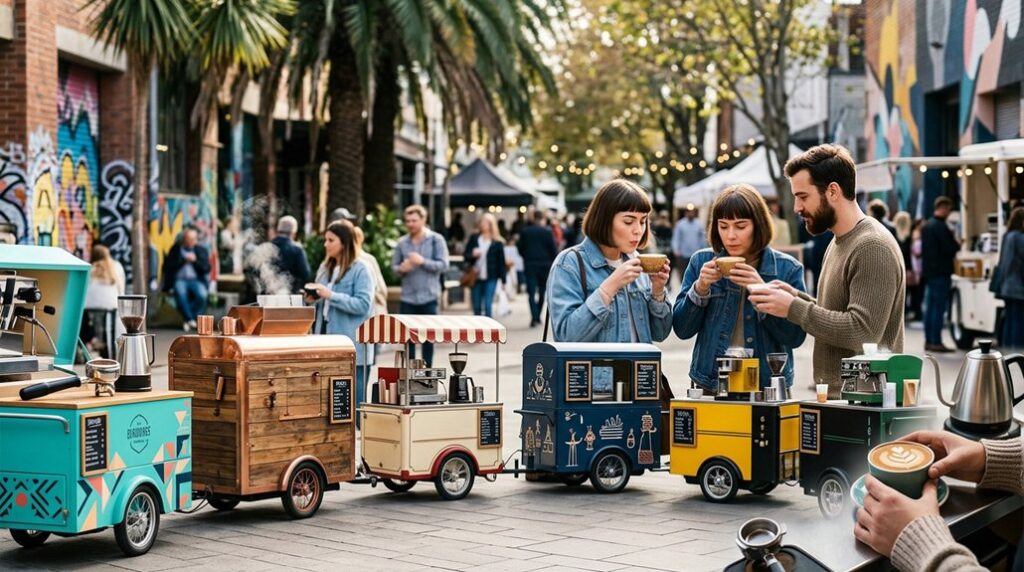
I’ve spent the last few years watching coffee carts evolve from simple espresso stands into legitimate revenue engines. Here’s what I’ve learned: the winners aren’t just making great coffee. They’re building businesses with multiple income streams, smart positioning, and realistic financial planning.
Whether you’re considering a compact rig or a full-service setup, the difference between success and burnout comes down to one critical decision made before you pour your first shot.
Start Legal: SoCal Permits, Health Departments, and Commissary Requirements
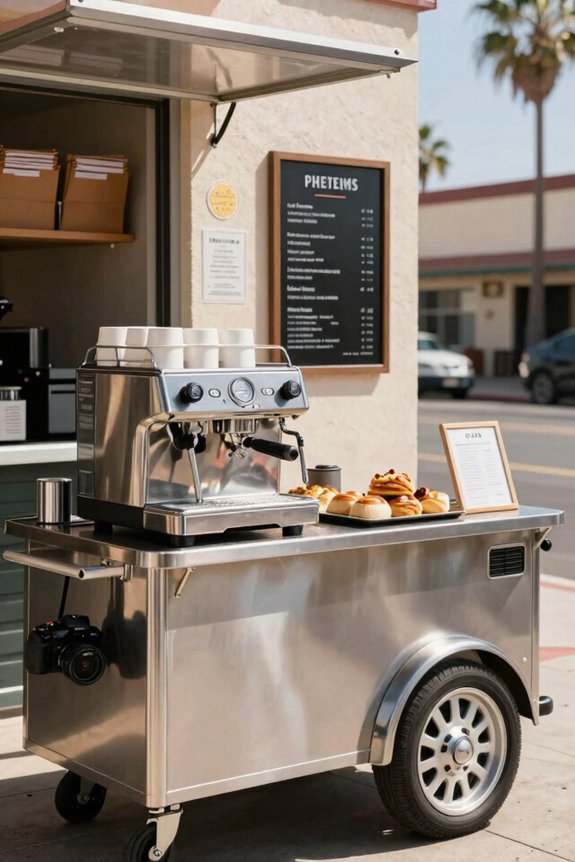
Before you brew your first cup or stock your first pastry, you’ll need to navigate the regulatory environment that keeps Southern California’s food operations safe and legitimate. I’m talking about health permits, your golden ticket to legal operation. You’ll need a Permit to Operate from your County Health Department, plus a general business license.
Here’s the non-negotiable part: securing commissary requirements. Most counties mandate a Commissary Agreement for licensed kitchens where you’ll store your cart and dispose of gray water. It’s required, not optional. Contact your local health department (LA County DPH, Orange County Environmental Health, or San Diego County DEH, depending on your location). They’ll guide you through plan checks and compliance with California’s Retail Food Code. Get these ducks in a row first.
Pick Your Cart Size: Compact Rigs vs. Full-Service Setups for Your Budget
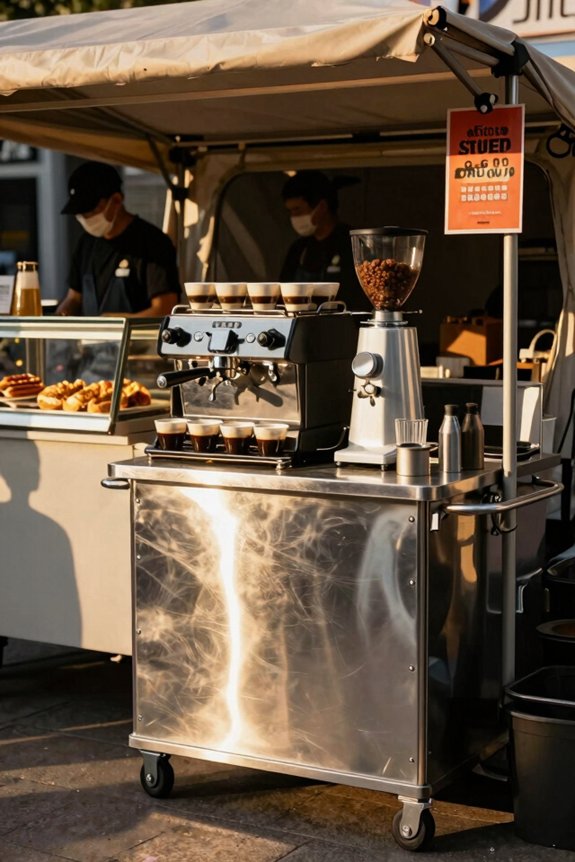
How much espresso are you actually going to pull in a week? That question shapes everything about your mobile coffee setup.
I’ve seen operators crush it with compact portable carts. Over 3,000 units prove farmers markets love the agility. You’ll spend less, move faster, test concepts. But if you’re running a full espresso program for 6+ hours daily, a Standard Mobile Cart becomes your real investment.
| Cart Type | Weekly Pulls | Setup Cost | Best For |
|---|---|---|---|
| Compact Rig | 200–400 | $8K–$15K | Testing, markets, flexibility |
| Standard Mobile | 600–1,200 | $25K–$45K | Established locations, volume |
| Premium Espresso Cart | 1,000+ | $40K–$70K | High-traffic events, revenue focus |
| Hybrid Setup | 400–800 | $18K–$30K | Balanced growth, versatility |
Your budget determines your espresso cart’s power. Choose wisely. You’re building community, not just selling coffee.
Choose Your Espresso Machine: Sanremo YOU vs. Synesso ES.1 Under Real Conditions
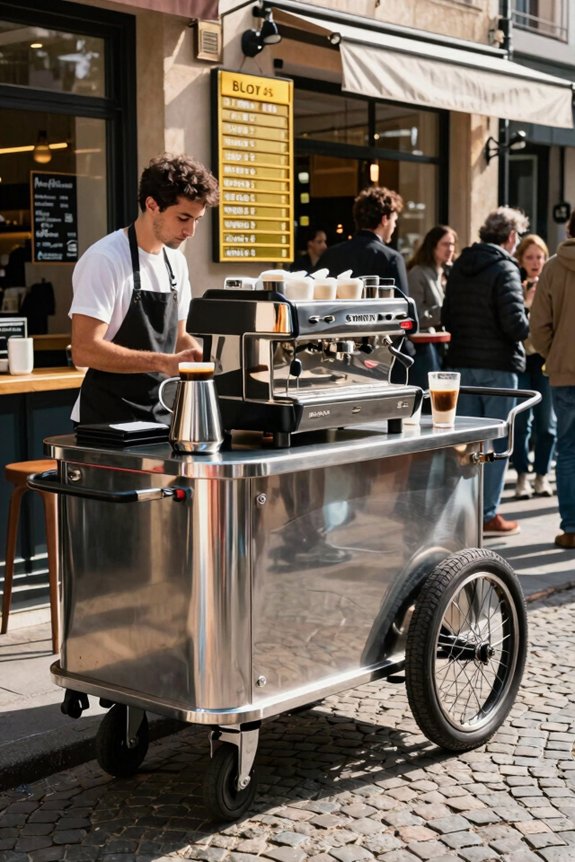
When you’re running 200+ shots daily on a mobile cart, you’ll face a critical choice: the Sanremo YOU’s compact footprint and dual-boiler stability, or the Synesso ES.1’s high-volume extraction precision. I’ve found that the YOU trips circuits less frequently in tight mobile setups, which is important when you’re operating on 110V, while the ES.1 shines during peak rushes by preserving those delicate roast notes your customers crave.
Pair either machine with a Compak E6 or i3Pro grinder, and you’re honestly choosing between bulletproof reliability in cramped spaces versus relentless consistency when the line gets long.
Compact Footprint & Performance
The espresso machine you choose makes or breaks your cart’s efficiency, and I’ve found that space and power constraints demand a strategic comparison between two standouts: the Sanremo YOU and the Synesso ES.1.
The Sanremo YOU delivers high-performance espresso within a compact footprint, perfect for tight mobile setups. Its dual-boiler system maintains stability while operating on 110V without circuit overload. You’ll pull 200+ shots daily without electrical drama.
The Synesso ES.1 prioritizes extraction precision during peak rushes, preserving roast notes when volume matters most. However, it demands more power and space.
Choose the Sanremo if your cart operates from standard outlets. Select the Synesso when you’ve secured dedicated power and anticipate sustained high-volume service. Both pair excellently with Compak grinders for consistency.
Dual-Boiler Stability Comparison
Stability under pressure, literally and figuratively, separates machines that merely function from ones that deliver consistency during your busiest hours.
I’ve found that dual-boiler systems fundamentally change your cart’s performance. The Sanremo YOU maintains thermal stability in compact setups, while the Synesso ES.1 handles high-volume rushes without compromising extraction quality. Both machines separate brew and steam boilers, eliminating the heat fluctuations that plague single-boiler competitors.
What matters most is recovery time between shots. I’ve observed the Synesso excel during afternoon rushes, preserving roast notes through back-to-back pulls. The Sanremo YOU offers superior space efficiency without sacrificing stability; crucial when square footage costs money.
Pair either machine with precision grinders like Compak E6 or i3Pro. That combination makes your shot consistency go from variable to predictable, building customer loyalty that justifies premium pricing.
High-Volume Extraction Precision
How do you maintain espresso consistency when you’re pulling 200+ shots in a single day?
I’ve found that espresso stability under high volume demands machines engineered for precision recovery. The Synesso ES.1 delivers rapid rebound between shots, preserving roast notes even during rushes. Meanwhile, the Sanremo YOU prioritizes compact stability with dual-boiler technology that minimizes temperature fluctuation.
Here’s what matters: throughput optimization isn’t just about speed; it’s about maintaining extraction quality. Pairing either machine with robust grinders like the Compak E6 maintains consistent dosing across hundreds of pulls. I recommend the Synesso if your cart thrives on back-to-back orders; choose the YOU if space constraints matter more than maximum capacity.
Both require 110V compatibility and disciplined maintenance routines. Your grinder choice ultimately determines whether you’re truly optimizing throughput or simply rushing through mediocrity.
Treat Your Water: Why Filtration Drives Profitability and Flavor
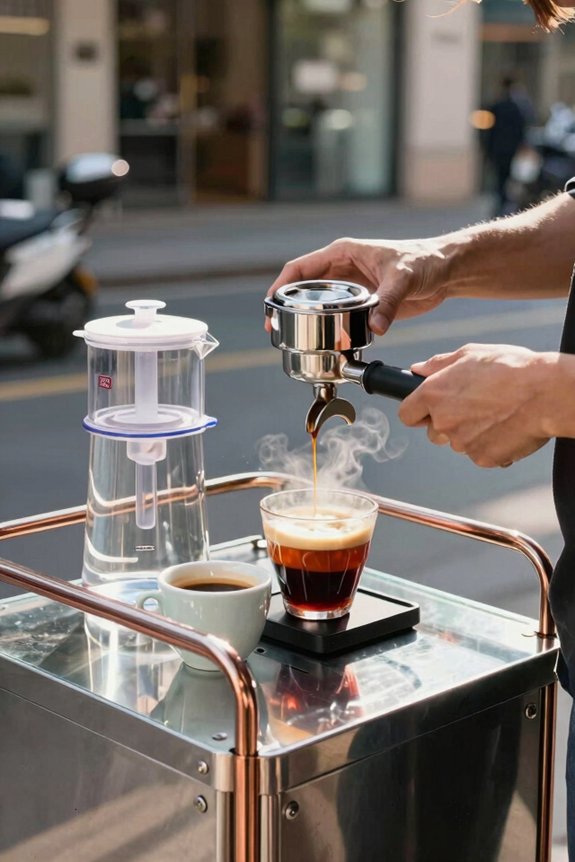
Why does your espresso taste flat on Tuesday but brilliant on Monday? SoCal’s mineral-heavy municipal water shifts with seasons, scaling your equipment and muddying that specialty coffee clarity you’re chasing.
SoCal’s mineral-heavy water scales equipment and muddies specialty coffee clarity—seasonal shifts demand serious filtration for consistent quality.
I’ve seen it happen: inconsistent extractions tank your reputation across 6+ hour shifts. Water filtration isn’t optional. It’s your profitability engine. The Caffewerks Hydro + Filter system removes chlorine and sediment, protecting your gear while preserving those nuanced flavor notes customers crave.
Without filtration, mineral buildup degrades equipment longevity, forcing costly repairs that sideline your cart. With it, you’re maintaining consistent quality, extending machine life, and delivering the taste that builds loyal crowds.
Treat your water seriously. Your bottom line depends on it.
Design for Revenue: Cart Aesthetics as Your First Marketing Asset
Your cart’s design is your first, and often only, chance to stop foot traffic dead. I’ve learned that branding isn’t just your logo; it’s how your entire cart speaks to customers before they taste a single espresso shot.
In Southern California’s competitive market, aesthetics separate thriving businesses from forgotten ones. You’ll want clean lines, impermeable surfaces, and a color palette that conveys quality. Think gallery-quality presentation, not generic street vendor.
Your cart functions as a mobile billboard. Simple, flat-pack designs maintain that high-end look while staying practical for farmers markets and corporate popups. Choose materials that photograph well, as they’ll drive your social media presence.
Strategic design isn’t vanity; it’s a revenue multiplier that attracts partnerships and justifies premium pricing.
Dial In Your Grinder: Consistency Tools That Handle Morning Rush Demand
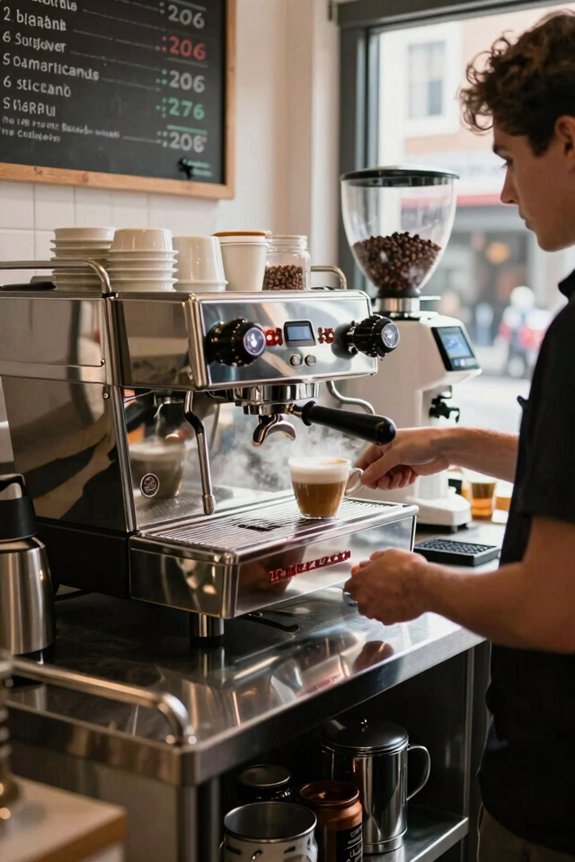
Grinder choice makes or breaks your morning rush. You’ll pull 200+ shots during peak hours, and inconsistent grinds destroy your reputation faster than burnt espresso smells. I recommend the Compak E6 or i3Pro; they’re heat-resistant workhorses with reliable grinder consistency that won’t quit when you need them most.
Here’s what matters: fast recovery between shots, minimal heat buildup, and easy on-site calibration. Match your grind size to your bean’s roast level and your machine’s pressure profile. A Sanremo YOU, for example, rewards precise dialing-in that preserves those roast notes customers crave.
Don’t skip maintenance either. Clean your burrs regularly, check dosing accuracy, and recalibrate often. That discipline prevents flavor drift across long service periods. You’re not just grinding beans; you’re building trust, one consistent shot at a time.
Validate Before You Scale: Testing at Farmers Markets and Pop-Up Events
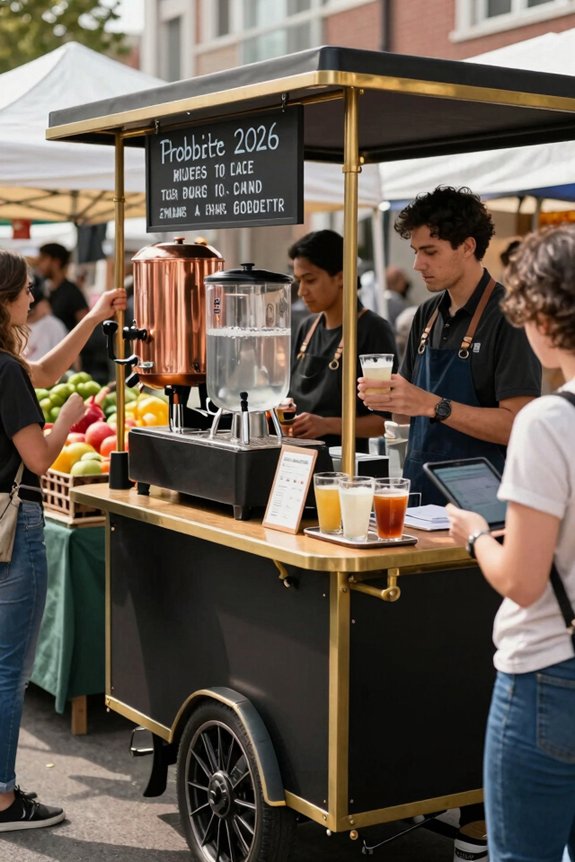
How do you know if your coffee cart concept actually works before you invest $15,000+ in a full-scale operation?
Test it first. I recommend starting at farmers markets and pop-up events where you’ll find your ideal customers without massive overhead. You’ll quickly see which drinks sell, what pricing sticks, and how people flow through your mobile cart setup.
Track three critical metrics: customer count per hour, average order value, and repeat visits. These numbers reveal whether you’ve got genuine interest or just initial curiosity.
Use this feedback to refine your menu, adjust pricing, and optimize your stall layout before committing to expansion. You’re also confirming permits and health compliance early, avoiding costly regulatory surprises later.
This validation phase converts instinct into data-driven confidence.
Multiply Your Income: Three Revenue Streams Beyond Cart Sales
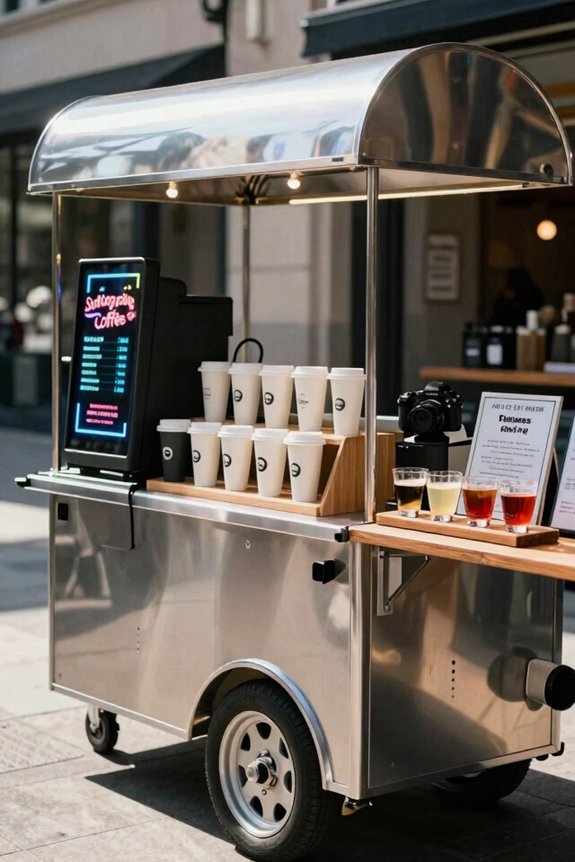
Once you’ve validated your cart concept and proven the numbers work, scaling beyond daily sales becomes your next move. I’ve found three revenue streams that build a cart into a sustainable business.
First, corporate popups with creative agencies in Downtown San Diego create recurring revenue. You’re not chasing foot traffic; clients come to you.
Second, retail bag sales of specialty coffee extend your brand beyond the cart. Customers who loved your espresso become repeat buyers at home.
Third, subscriptions convert daily regulars into predictable monthly income. I’ve seen this stabilize cash flow dramatically while increasing lifetime customer value.
These streams work together. Each one reinforces the others, building a location-agnostic business that doesn’t depend solely on cart sales.
Know Your Numbers: Realistic Startup Costs and Break-Even Timelines
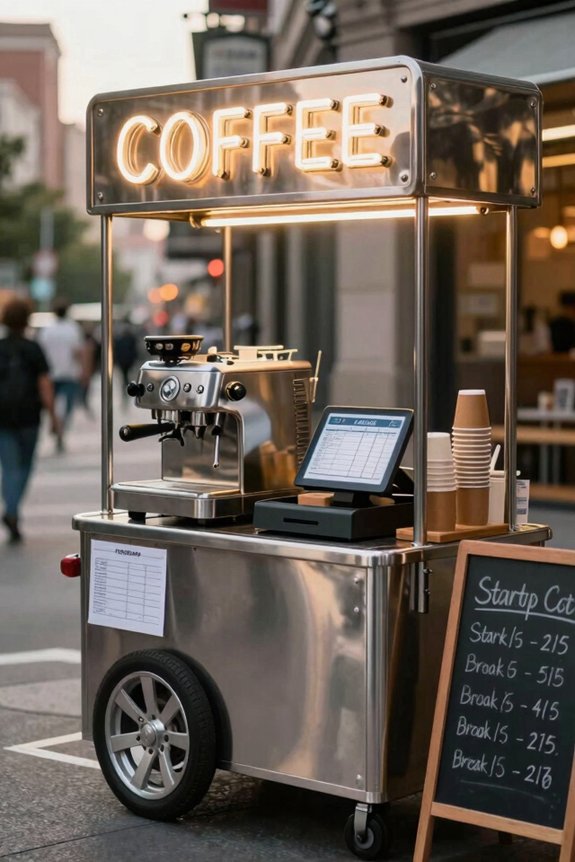
Why do so many coffee cart operators stumble within their first year? They’re flying blind on their numbers.
I’ll be straight with you: realistic startup costs range from $5,000 to $20,000, depending on your cart size and equipment choices. Your break-even timeline is determined by securing permits early and nailing your cost structure.
| Equipment | Cost Range | Priority |
|---|---|---|
| 110V Espresso Machine | $3,000–$8,000 | Critical |
| Precision Grinder | $1,500–$3,000 | Critical |
| Water System | $800–$1,200 | Essential |
| Permits & Commissary | $500–$2,000 | Non-negotiable |
| Initial Inventory | $500–$1,500 | Startup |
Here’s the real move: diversify revenue through corporate popups and retail bags. This shrinks your payback period dramatically.
When you leverage tools like Torque Coffee’s calculators, you’re not guessing anymore. You’re strategizing like a peer who knows what wins.
Grow Your Brand: When and How to Hire Help or Partner With Mentors
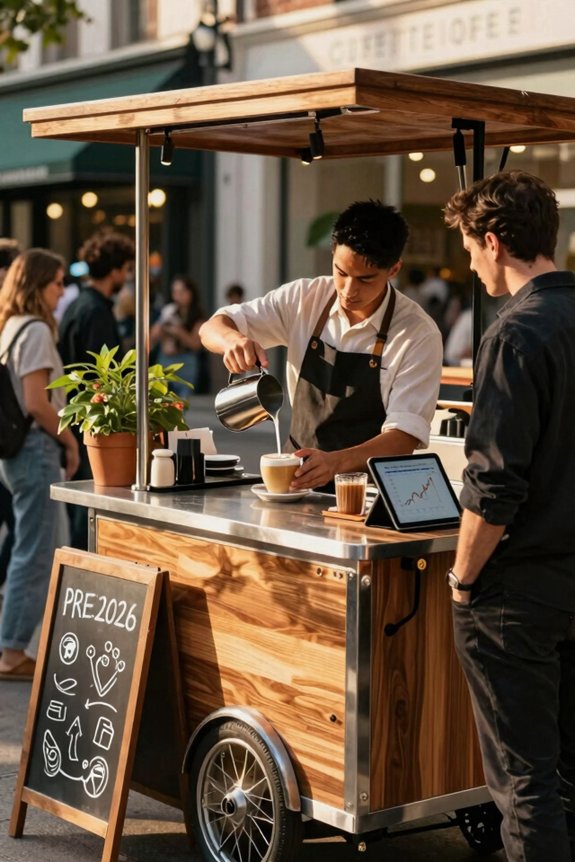
As you scale your coffee cart beyond solo operations, you’ll hit a ceiling where your time becomes your limiting factor. That’s exactly when bringing in mentorship or strategic partnerships changes everything. I’ve seen founders who tried to figure out permits, equipment selection, and margin optimization alone waste thousands in mistakes, while those who partnered with experienced operators compressed their learning curve by months.
Whether you’re hiring your first employee, launching a second cart, or building subscription revenue streams alongside your mobile business, the right support structure doesn’t just speed growth, it protects your profitability.
Scaling Operations Through Support
Most coffee cart operators hit a ceiling around year two: you’re pulling espresso shots at 5 a.m., managing inventory at lunch, and handling permits after hours.
That’s when mentorship changes everything. Strategic support accelerates what takes others years to figure out independently.
| Support Type | What You Get | Timeline Impact |
|---|---|---|
| Fractional COO guidance | Equipment selection, Type 53 permits | Months, not years |
| Coffeeshop franchising models | Scalable systems across locations | Sustainable growth |
| Profitability mentorship | Revenue optimization strategies | Immediate cost reduction |
You’re not flying solo anymore. Partners who’ve navigated mobile permits, retail pivots, and subscription models become your competitive advantage. They show you compliance shortcuts, equipment choices that protect margins, and which revenue streams actually work in SoCal’s market.
This belongs to you: accelerated scaling through proven expertise, not trial and error.
Strategic Partnership & Mentorship Models
You’ve mapped your cart’s operations, optimized your margins, and hit consistent daily sales, but you’re still grinding through every shift yourself. That’s when strategic partnership and mentorship create significant change.
I’ve found that mobile coffee operators thrive when they tap into experienced guidance. A fractional COO helps you navigate Type 53 permits, select equipment strategically, and build sustainable systems. Mentorship programs focus on turning your coffee hobby into a scalable Southern California brand through founder-focused coaching.
The real value emerges when you partner for revenue diversification. Popups, retail bags, and subscriptions accelerate market penetration. You’ll gain profitability calculators, operational frameworks, and location strategy insights that fast-track your path from proof-of-concept to multi-location operations.
You’re not building alone anymore. You’re building with people who’ve done this before.